
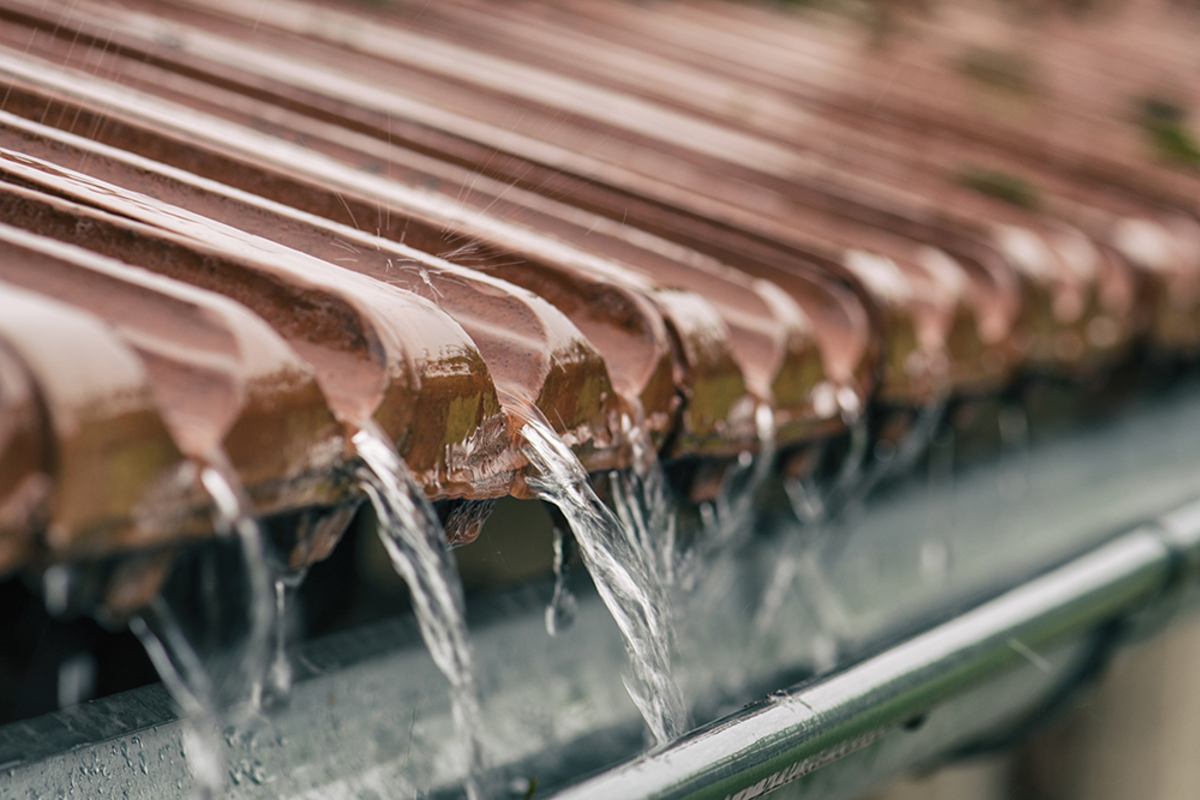
A hard Kansas City storm has a way of finding the weak spot in a gutter system. Homeowners call us every spring wanting to know why their gutters overflow in heavy rain when the last cleaning was only a few months back, and the trough still looks clean from the ground.
What the Overflow Spot Tells You
Before anyone climbs a ladder, we ask homeowners to step outside during the next hard rain and watch for about a minute. The location of the spill narrows the cause fast.
Water Spills at One Corner or Section
A single problem spot points to a localized issue. Expect a sag, a low point in the run, or debris packed near an outlet.
Water Sheets Over the Middle of a Long Run
Overflow spread across a whole section during downpours usually signals a capacity problem. The gutter simply cannot pass water as fast as the roof delivers it.
Water Runs Down the Fascia Board
Water tracking behind the gutter instead of into it is the most urgent version of this problem. Damage happens out of sight, and it moves into the wood.
Key Takeaway: Gutters that stay dry inside while water pours onto the ground are not clogged. Water is getting past them before it ever lands in the trough.
Five Causes and Fixes
1. Clogs in the Trough, Outlet, or Guard
Leaves get the blame, and they earn some of it. Maple and sycamore seeds in spring, cottonwood fluff in early summer, and the late October leaf drop all pile into the same few inches of channel.
Downspout outlets clog more often than the trough itself. Shingle granules in the mix are worth noting separately, since heavy granule loss points to an aging roof.
The fix: Clean twice a year at minimum, and flush every downspout with a hose until water runs clean at the bottom. Poorly installed or low-quality gutter guards belong in this category too, because foam inserts and flat screens can trap debris on top and make overflow worse.
2. Poor Pitch or Sagging Sections
Gutters need roughly a quarter inch of fall for every 10 feet of run toward the downspout. Flat or reversed sections hold standing water, which adds weight and pulls the run further out of line.
Older spike and ferrule systems back out over time. Water then pools in the dip and spills there during every serious rain.
The fix: Reset the run with hidden hangers screwed into solid fascia. If the fascia has gone soft, the board needs attention first, since new fasteners will not hold in rotted wood.
3. Undersized Gutters and Too Few Downspouts
Capacity depends on roof area, roof pitch, and how hard it rains. A steep roof delivers water faster than a shallow roof of the same footprint, and our spring storms produce short bursts of very high-intensity rainfall.
Many homes here were built with 5-inch gutters and 2-inch by 3-inch downspouts. That combination struggles on large or steep roof planes.
The fix: Move up to 6-inch gutters with 3-inch by 4-inch downspouts, or add downspouts to the existing system. Adding a downspout is often the cheaper first move, and it solves more problems than people expect.
Pro Tip: Count your downspouts. As a general rule, plan on one for every 30 to 40 feet of gutter run, and more on steep or oversized roof sections.
4. Roof Valley Overshoot
Where two roof planes meet, the valley funnels water into a concentrated stream that can launch straight over the gutter during a downpour. Homeowners assume a clog and find a clean, dry gutter underneath.
This one is common on homes with complex rooflines, which describes a lot of newer construction across Overland Park and Lee’s Summit.
The fix: Install a valley splash guard or diverter at that section. It is an inexpensive correction that solves the problem completely.
5. Missing or Short Drip Edge
Water clings to the underside of the shingle edge and travels backward into the fascia and soffit rather than dropping into the gutter. From the ground, it looks like overflow.
Damage accumulates quietly here. Rotted fascia, soggy soffit, and eventually water reaching trim and window framing below.
The fix: Add drip edge or a gutter apron along the roof edge so runoff is directed into the trough where it belongs.
Why Do Gutters Overflow in Heavy Rain Even After a Cleaning?
Causes three through five have nothing to do with debris. Homeowners who clean religiously and still see water pouring over the front edge are almost always dealing with capacity, valley overshoot, or a roof edge detail.
Need help sorting out which one is affecting your home? Contact Energy Pro Windows for a free, no-pressure inspection.
What Overflowing Gutters Cost a Kansas City Home
Foundation and Basement Problems
Water dumping at the base of the wall saturates soil against the foundation. Our clay soils swell and shrink with moisture, and repeated saturation is a real contributor to basement seepage and settling.
Rot in Fascia, Soffit, and Window Trim
Wet wood at the roof edge is the most common damage we repair after chronic overflow. Left long enough, it travels down into trim, sills, and framing around windows.
Stained and Saturated Siding
Splash back leaves streaks along the lower courses and pushes moisture behind the siding at corners and seams.
Key Takeaway: Gutter overflow rarely stays a gutter problem. Standing water in a poorly pitched run also gives ice dams a head start during our freeze and thaw cycles.
When to Handle It Yourself and When to Call Us
Reasonable Weekend Jobs
- Cleaning the trough by hand and flushing downspouts
- Adding or lengthening downspout extensions to move water 4 to 6 feet from the foundation
- Installing a splash guard at a valley
- Tightening a loose hanger or two
Work Worth Hiring Out
- Repitching an entire run
- Resizing gutters or adding downspouts
- Anything involving soft or rotted fascia
- Second story work and steep roof access
- Gutter guard installation, where pitch and placement determine whether the system performs
Our team handles gutter guards, wood rot repair, siding, and replacement windows, which matters here because chronic overflow tends to create work in all four areas at once.
Get Ahead of the Next Storm
Most overflow problems are inexpensive to correct and expensive to ignore. A short inspection tells you whether you are looking at a cleaning, a splash guard, or a system that was undersized from the day it went up.
We have served Kansas City homeowners since 2003. Request a free quote, and we will show you exactly why your gutters overflow in heavy rain and what it will take to stop it.